12-Strand Combination Rope
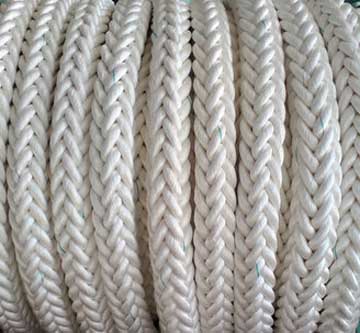 A braided 12-Strand Polyester over Polyolefin dual fiber rope made in single-ply or double-ply construction. The Polyester and Polyolefin composite is wrapped around the Polyolefin fiber, which provides UV protection and offers a great industrial strength to weight ratio. This line is easy to splice, light weight and extremely flexible and is 40% stronger than 3-strand "Poly/Dac" ropes.
- Dependable 12-strand construction
- Light weight, easy to handle
- Urethane Clear Coated
- Non-Rotational
- Abrasion resistant
- Lower stretch than nylon rope
- Durable construction
- Long service life
- Easy to splice
- Quality polyolefin monofilament jacketed with premium polyester
- Low elongation
- Made in the USA
12-Strand Combination Specifications
Diameter
Cost per foot
Average break strength
1-1/8"
$2.38
45,000 lbs
8-Strand Polypropylene / Polyester Blend Rope
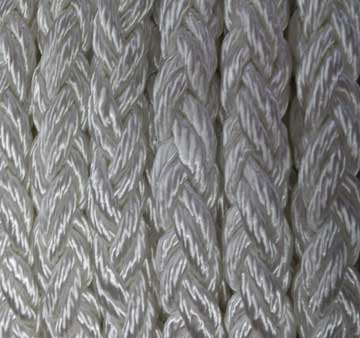 The best properties of two comparable fibers, polypropylene and polyester, create a very high strength, light weight and competitively priced rope. Polypropylene provides a high strength, light weight core while the polyester cover yarns provide excellent resistance to abrasion and UV degradation which extends the service life of the rope.
- Light weight, easy to handle
- Non-coated
- Abrasion resistant
- Non-Rotational
- Durable construction
- Long service life
- Easy to splice
- Quality polypropylene and premium polyester blend
- Low elongation
- Made in the USA
8-Braid Polypropylene and Polyester Blend Specifications
Diameter
Cost per foot
Average break strength
1-1/8"
$2.38
45,000 lbs
3-Strand Twisted SuperPro®
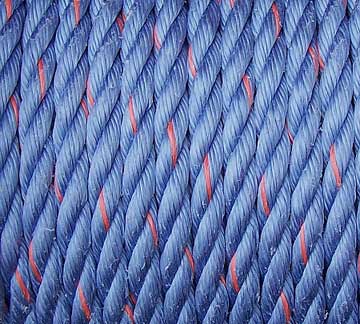 Sima extrusion process blends polypropylene and high modulus polyethylene resins to produce the co-polymer fiber used in making SuperPro® rope. SuperPro® is 35% stronger and has many times the abrasion resistance of conventional polypropylene products, with low elongation characteristics equivalent to pure polyester. Testing has shown that SuperPro® significantly outperforms other "blended olefin" fibers that are extruded using processes other than Sima. SuperPro® co-polymer rope offers the best performance price value.
- 35% stronger than polypropylene
- Non-coated
- Abrasion resistant
- Durable construction
- 30% better UV resistance than polypropylene
- Long service life
- Artic blue with orange tracer
- Special "ski hill" lay and twist for longevity
- Easy to splice
- Quality polypropylene and polyethylene blend
- Low elongation
- Made in the USA
3-Strand Twisted PolyPro® Specifications
Diameter
Cost per foot
Average break strength
1-1/8"
$1.89
26,812 lbs
CAUTION: USE OF WORKING LOADS
Because of the wide range of rope use, rope condition, exposure to the several factors affecting rope behavior, and the degree of risk to life and property involved, it is impossible to make blanket recommendations as to working loads. However, to provide guidelines, working loads are tabulated for rope in good condition with appropriate splices, in non-critical applications and under normal service conditions.
The Cordage Institute Formula for working load is:
Working Load = Minimum Breaking Strength/Safety Factor
A higher working load may be selected only with expert knowledge of conditions and professional estimate of risk. Also, if the rope has not been subject to dynamic loading or other excessive use, has been inspected and found to be in good condition, is to be used in the recommended manner; if the application does not involve elevated temperatures, extended periods under load, or obvious dynamic loading (see explanation below) such as sudden drops, snubs or pickups. For all such applications and for applications involving more severe exposure conditions, or for recommendations on special applications, call Jay at 763-263-9835.
**Many uses of rope involve serious risk of injury to personnel or damage to valuable property. This danger is often obvious, as when a heavy load is supported above one or more workmen. An equally dangerous situation occurs if personnel are in line with a rope under tension. Should the rope fail, it may recoil with considerable force. Persons should be warned against the serious danger of standing in line with any rope under tension. IN ALL CASES WHERE SUCH RISKS ARE PRESENT, THERE IS ANY QUESTION ABOUT THE LOADS INVOLVED OR QUESTIONS ABOUT THE CONDITIONS OF USE, THE WORKING LOAD SHOULD BE SUBSTANTIALLY REDUCED AND THE ROPE PROPERLY INSPECTED.
DYNAMIC LOADING VOIDS NORMAL WORKING LOADS
Normal working loads are not applicable when the rope is subject to significant dynamic loading. Whenever a load is picked up, stopped, moved or swung there is an increased force due to dynamic loading. The more rapidly or suddenly such actions occur, the greater the increase will be. In extreme cases, the force put on the rope may be two, three or even more times the normal involved. Examples could be picking up a tow on a slack line or using a rope to stop a falling object. Therefore, in all such applications such as towing lines, lifelines, safety lines, climbing ropes, etc. working loads as given DO NOT APPLY.
Users should be aware that dynamic effects are greater on a low elongation rope such as polyester than on a high elongation rope such as nylon, and greater on a shorter rope than on a longer one. The working load ratios listed contain provision for very modest dynamic loads. This means, however, that when this working load has been used to select a rope, the load must be handled slowly and smoothly to minimize dynamic effects and avoid exceeding the provision for them.
EFFECT OF TEMPERATURE ON TENSILE STRENGTH
The tensile strength charts apply to ropes tested at normal room temperature (70°F). Ropes have lower tensile strengths at higher temperatures. 30°F (or more) lower at the boiling point of water (212°F) and continuing on down to zero strengths for nylon and polyester at 490°F and 300°F for polypropylene.
Also, continued exposure at elevated temperatures causes permanent damage. TENSILE STRENGTHS shown are average based on new ropes tested under laboratory conditions, minimum can vary by 10%.
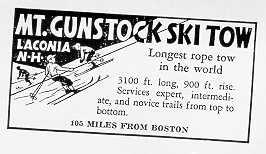 The first tow rope is recorded to have begun operation in Quebec in 1932. The following year a copy was opened in Woodstock, VT. In 1934, Ted Cooke ox-hauled his rope tow into position for a February 1935 opening at Gunstock with the worlds longest rope tow.
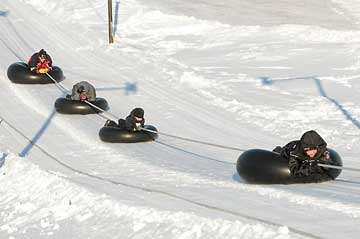 Safety is a key requirement in ski tow ropes. The natural tendency of ropes to revolve under tension introduces an element of danger in standard lay construction ropes. A revolving rope can catch gloves, parkas, sweaters and scarves. These ski tow ropes are specially constructed to offer a non-revolving line.
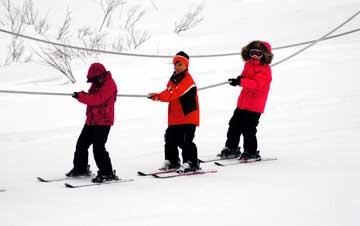 The special construction offers high resistance to the severe abrasive wear of dragging over snow and ice in addition to the non-revolving factor. The combination of polyester and polyethylene filament gives light weight, long wear, and excellent abrasive resistance and low external and internal wear. It will not fuse on the sheaves nor freeze-up and will not rot.